robotnic.co

  • Home
  • Hello!
  • Reading Week
  • 52 Books

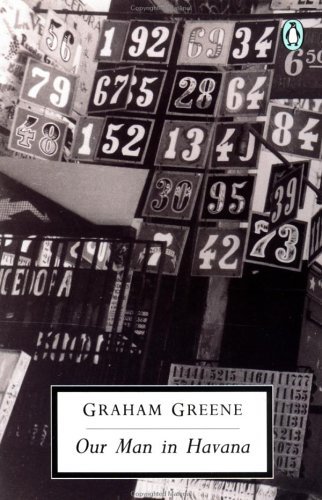
Book Review: Our Man in Havana

08.19.2010 by Nicola //

I am loathe to disagree with Christopher Hitchens, who wrote the introduction to this book, but as difficult as it is to denounce the opinion of a man who most certainly knows better than me — I’ll do it.

Our Man in Havana centres around British expatriate and vacuum salesman Mr Wormold – seldom referred to as Jim, even his nearest and dearest. Struggling to care for his 17 year-old, devout Catholic daughter, Wormold is head-hunted by the British secret service. In order to maximize his earnings, Wormold, rather than hiring agents, invents some.

The story is overrun with dialogue, which is often unmarked and therefore difficult to follow. Though there are some interesting characters, their emotional distance is palpable and demonstrated by their formal addresses. The story centres on Wormold but is narrated in third-person, which is often confusing.

Most exposition on the storyline is delayed, leaving that disgruntled, anti-climactic moment where you feel like you might have missed something. While this probably works perfectly in the film, the big reveals are sidelined; dulling the effect of the big give-away instead of enhancing it. At many points I felt that I could almost have skimmed over some of the most important moments.

Intriguing, but never quite entertaining, Our Man in Havana is a sleepy espionage tale for dads.
Book #30: ★★★★★

Categories // Books

Book Review: Wake Up, Sir! by Jonathan Ames

08.17.2010 by Nicola //

Wake Up, Sir! is the third novel from Jonathan Ames, author and creator of HBO’s Bored to Death. The show was adapted from a short story of the same name, and stars Jason Schwartzman as Jonathan Ames, Ted Danson, and Zach Galifianakis (try spelling that drunk). After attending the Bored to Death event at Edinburgh International Film Festival and spying Ames at the closing party, I decided it was time to see what this eccentric New Yorker was all about.

Wake Up, Sir! is narrated by one (unreliable) Alan Blair, an accidental quarter-millionaire and, like Ames in Bored to Death, an author struggling to write his second novel. Oh, and he’s also a neurotic alcoholic. After a run-in with his Uncle whom he has been living with and avoiding, he packs up his belongings and his valet, sardonically named Jeeves, and departs on a journey to detox and finish his novel. After several more incidences, he finds himself at an artists’ retreat with goods more damaged than his own.

Ames’ Alan Blair is a humorous chap, with an acute sense of humour that cloaks a complete lack of worldliness. While amusing at points, the tension between his sharp wit, dull social skills, and impossible naivety are too far at odds to be taken seriously. Jeeves levels him out with his cool, unflappable demeanour and impenetrable patience. Despite his quiet, he is perhaps the most interesting character in the book.

Though the plot unfolds over 4 days, it feels more like 4 weeks (as noted by Alan). Amusing and oftentimes fantastic, it can be a little overzealous at times, but is well worth the journey.

Book #29: ★★★★★

—

This week is going to be Book Week, in part as celebration of Edinburgh International Book Festival, and in part because I’ve been reading lots and watching very few films. Enjoy!

Categories // Books

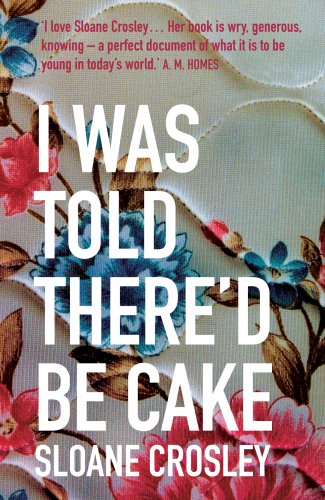
Book Review: I Was Told There’d Be Cake by Sloane Crosley

08.09.2010 by Nicola //

Sloane Crosley’s humorous memoirs are in the vein of David Sedaris, to whom she is frequently and flatteringly compared; likely for want of a better description.

While Crosley operates within the same outline, her craft is not in the same league as Sedaris or, my preferred contemporary of the same genre, Augusten Burroughs.

The beauty of the personal essay is the delicate balance between mundanity, the oddness of life, and the gentle self-deprecation of the author. Add a dash of clever wording, a few humorous descriptions, and the odd comic digression, and you’re in business. What makes Sedaris so unique and, most importantly, so absorbing, is his ability to reel you in with a mundane or wacky story and, at the end, wrap it up neatly with an overarching theme, message, or feeling imbued with importance. On all of these counts, Crosley fails.

From getting locked out of both her flats on moving day to her year as the assistant to a Miranda Priestly-esque publisher, the stories become no more interesting beyond the gist. While the writing itself is not at fault, the stories are mundane to the point of boring and, unlike Sedaris’ essays, lack pathos.

That is not to say that she doesn’t try. In her essay ‘Bastard Out of Westchester’ Crosley attempts to relate her wish for her kids to be “different” (which equates to being foreign) to the existential crisis she has invented around the uniqueness of her first name, Sloane. This attempt at taking two seemingly unrelated statements and, with the dexterity of words, making them fit feels more like a small child on tippy-toes reaching for the cookie jar and the sugar bowl at the same time with both tiny hands.

Pathos aside, what is worse is that her essays are not funny. While I seldom laugh out loud at Sedaris (and know I am pretty much alone in that regard), Burroughs is second only to Bryson in his ability to make me giggle, snort, then chase after the nearest bystander, tears streaming and forefinger stabbing wildly at the page.

Sorry, Sloane. I wish this genre was big enough for the three of you, but when you punch wildly into a genre with established masters, they are inclined to win.

If you’re still intrigued by the humorous memoir, I recommend Augusten Burrough’s Magical Thinking.

Book #28: ★★★★★

Categories // Books

  • « Previous Page
  • 1
  • …
  • 61
  • 62
  • 63
  • 64
  • 65
  • Next Page »

Copyright © 2026 · Modern Studio Pro Theme on Genesis Framework · WordPress · Log in